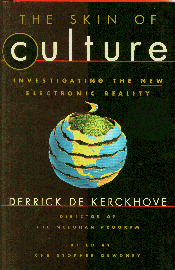
Adapted from The Skin of Culture: Investigating the New Electronic Reality. by Derrick de Kerckhove. Edited by Christopher Dewdney. Published in Toronto by Somerville House Publishing, 1995.Reprinted by permission. CompuServe: 75143,3317. Internet: SomBooks@goodmedia.com |
 |
***
It's a truism to say we don't miss what we don't know and another to say that advertising creates needs that aren't there in the first place. Such banalities are based on the unquestioned assumption that all men and women were created not only equal, but once and for all and forever the same. Nothing could be further from the facts of life. We are forever being made and remade by our own inventions. The myth of humanity's base-line universality is just a product of an eighteenth-century philosopher's wishful thinking.
Our psychological reality is not a "natural" thing. It is partially dependent upon the way our environment, including our own technological extensions, affects us. One way to understand psychology, both as a fact of life and as a science, is to propose that its purpose is to provide a comprehensive and self-updating interpretation of our lives as they are being affected by our ever-changing cultural ground. Hence, among its many regulating functions, psychology's role may be to interpret and to integrate the effects of technology upon us. One of the functions of our personal psychology is to create an illusion of continuity when there are major cultural and technological breaks and, thus, to slow down the effects of technological feedback on our nervous system. If we did not have some sort of personal stabilizing environment, we would be in a permanent state of shell shock from dealing with the cultural trauma of new technologies. We would be like Chancy Gardiner, the main character in Jerzy Kosinski's novel Being There. After living his whole adult life in front of television, Chancy walks out into the street for the first time and finds to his utter dismay that, for some unaccountable reason, his remote control no longer works.
While scientists and technocrats are busy looking to perfect our bodies and our minds according to the old model of the renaissance man, our daily technologies are changing us insidiously in a manner that will soon be unrecognizable to obsolete scientific paradigms. The scientific image of the human is that of a perfect machine with replaceable parts. In genetic engineering, the image is only slightly improved. The machine can build itself according to specifications only if you know how to modify the programming. The future of health and fitness lies in the concept embodied by the replicant in Bladerunner. The vicious circle is easy to predict: techno-science will build scientifically balanced organisms to perform scientifically calculated operations to perfection. The computer made flesh. There is no soul to this machine because there is no room for anything but an operational self in the scientific/robotic vision of this being. We certainly need a Babelian catastrophe to avoid that destiny, if it is indeed the direction we are going.
But, in fact, it isn't. Science is no better than science fiction at predicting reality. Science does not know where we are going because it has abandoned the quest for "why" to devalued religions. It cannot know the future because it is hardly capable of assessing the present. Lost in conceptual spinnings, interlocking theories and stupefyingly simplistic experiments, most professional scientists are clearly void of any but the crudest perceptions. As Karl-Heinz Stockhausen suggested, today we are invited to "see more, hear more and feel more." This is an artist's statement. Few people apart from artists are capable of predicting the present. Our technologies already make us see more, hear more and feel more. But no self-respecting psychologist in any American university would even be willing to consider that the extensions of our sensory experiences might have a feedback effect on our psychological experience. The role of the artist today, as always, is to recover for the general public the larger context that has been lost by science's exclusive investigations of text.
But Stockhausen's suggestion is not that we be satisfied with television carrying our eyes to the end of the planet, or that we marvel that the telephone brings us voices from afar, or that we learn to touch screens and virtual textures. What he recommends is that we let our senses teach us to become new people, better adjusted to the real dimensions of mankind extended beyond the reach of our natural senses.The job of the artist who addresses the new media and the new machines is to not to praise or condemn technology, but to bridge the gap between technology and psychology. Our new technological artforms in John Sanborn's videos, in Karl Sims' comp graphics, in Dieter Jung's holography, in Monica Fleishmann's virtual realities are but expanded metaphors of our technically extended senses. And a word such as "telesensitivity" only begins to describe it.
To see more is not merely to see further away, beyond the confines of our walls and our present horizons. It is to develop a new precision and flexibility in our eyes; it is to see behind our backs as well as in front of our eyes; it is to perceive the world not exclusively in a frontal relationship, but in a total surround; it is to multiply the facets of our eyes and the objects of our simultaneous gaze as if all the cameras of the world were the realization of a new Argus.
To hear more is to know how to find the sound behind the sound, behind the fury of the city and behind the cacophony of the media. To hear more is to learn with David Hykes and the Harmonic Choir that, yes, for centuries we have obliterated the harmonics of those sounds that support meaning, the only ones we know how to hear. For centuries we have failed to hear the divine subtleties of echoing and blending harmonies ever present in the environment. John Cage said that silence is the sum of all the sounds of the environment at once. He could also have said that silence is alive.
To feel more is the most important. Paracelsus said that the ear is not an extension of the skin, but that the skin is truly an extension of the ear. Of course, after we learn to read and write, we learn to close within our skin the silent contents of our minds. We learn to use our skin as an excluding device. We become quite terrified of touch, of bodily contact, of other people's bodies and of our own, more than of anybody else's. Then the skin can only hurt. It needs the protection of layers of clothing. Other people's touch can only hurt. Our privacy needs the protection of guilt.
To the electronic extension of our body, such a perception of the skin is abhorrent. McLuhan suggested that "in the electric age, we wear all mankind as our skin." That makes perfect sense. The skin as a communicating not a protecting device makes perfect sense. Eugene Gendlin, the little-heeded American psychologist who invented the notion of "felt-meaning" to describe how our bodies process information with as much, if not more speed and accuracy than our minds, opened for us a new field of tactile perceptions, beyond the limits of the individual body. I cannot watch too much violence on TV, not because I fear that it will desensitize me as so many unimaginative commentators hasten to suggest, but because I cannot take too many blows in my neuromuscular responses.
The violence of the few is the result of the insensitivity of the many. To feel more is to begin to get ready for a proper understanding of the world we are getting into. It is a way to avoid a Babelian catastrophe. To expand the reach of our sociopsychological responsibility, as well as to discover a new global and collective Renaissance, the role of art is paramount. The real issue is to change our perceptions, not just our theories. Telecommunication art helps us to perceive that we are becoming larger people as we look back on our planet from space and discover that the real size of our collective body is the planet itself. Interactive arts and the proliferation of sensory interfaces can make us realize that we use our extended minds and bodies as tuning mechanisms to monitor the state of health of the Earth. We are invited to refine our proprioception to extend our point of being (rather than our point of view) from wherever we are to wherever our technically extended senses can allow us to reach.
is Professor in the Department of French and Director of the McLuhan Program in Culture and Technology at the University of Toronto. His close association during the seventies with Marshall McLuhan gave de Kerckhove privileged access to the inner workings of this century's pre-eminent media philosopher.
Circuit Traces wants to know what you think. Please send your comments
to the editor.
Copyright Circuit Traces Communications 1995